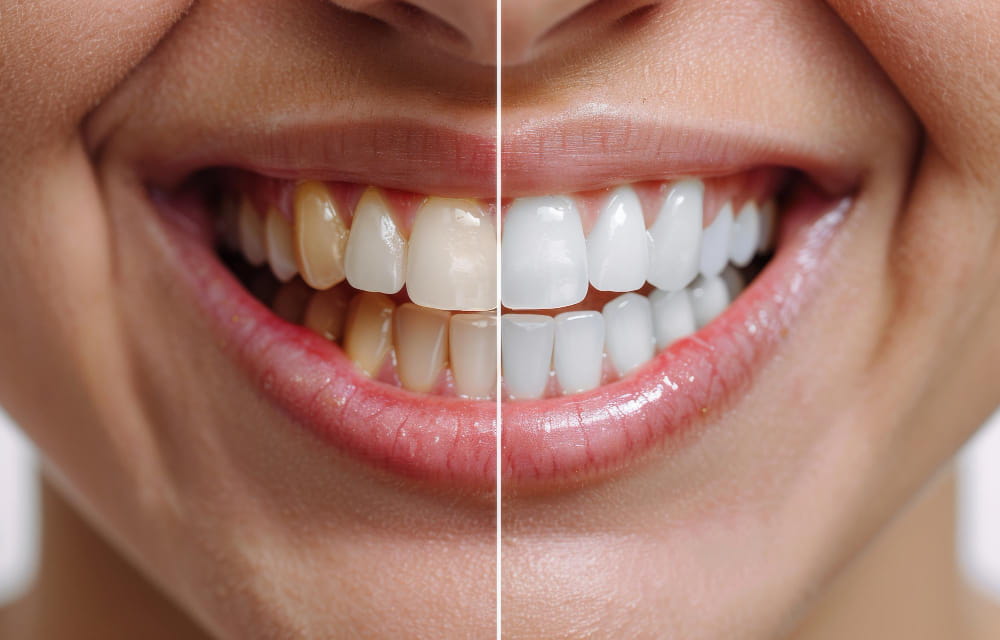
Teeth whitening in Antalya is a cosmetic dental treatment that lightens tooth colour by removing or reducing stains from the enamel and dentin. It is one of the most requested treatments for patients who want a cleaner, brighter smile without changing the shape of their natural teeth. Professional whitening can improve stains caused by coffee, tea, red wine, smoking, ageing, and certain food pigments, but the result depends on the type of staining, enamel structure, and the patient’s oral health.
In a dental clinic, whitening is performed with controlled bleaching gels, usually containing hydrogen peroxide or carbamide peroxide. These agents release oxygen molecules that break down coloured compounds inside the tooth structure. The aim is not to “paint” the teeth white. The treatment works from within the tooth surface, which is why professional whitening can look more natural than temporary whitening products.
Antalya is a preferred destination for teeth whitening because patients can combine cosmetic dental care with a structured appointment plan, modern clinic technology, and accessible treatment prices. In many cases, in-office whitening can be completed in a single appointment of around 60 to 90 minutes. Some patients may benefit from home whitening trays prepared by the dentist, used over 1 to 2 weeks.
Teeth whitening is best planned after a dental examination. Cavities, leaking fillings, gum inflammation, exposed roots, and heavy tartar should be treated before whitening. Whitening does not change the colour of crowns, veneers, fillings, or bonding, so existing restorations must be considered before treatment. A properly planned whitening treatment should brighten the smile while protecting the gums and keeping sensitivity under control.
What Is Teeth Whitening?
Teeth whitening is a dental procedure that lightens the natural colour of teeth by breaking down stains and pigments inside the enamel and dentin. It is designed for natural tooth tissue, not artificial restorations. This means crowns, veneers, fillings, bridges, and composite bonding will not whiten in the same way as natural teeth. If a patient has visible restorations in the smile area, we need to plan shade matching carefully before starting.
Tooth discolouration can be external or internal. External stains sit on the surface of the enamel and are often caused by coffee, tea, tobacco, red wine, colourful sauces, and plaque buildup. These stains may improve with professional cleaning and polishing. Internal stains are deeper and may be linked to ageing, medication history, trauma, enamel structure, or long-term pigment absorption. Whitening gels are more useful for these deeper colour changes because they penetrate the tooth surface and break down stain molecules.
Professional whitening is usually performed with hydrogen peroxide or carbamide peroxide gels. These materials are applied under controlled conditions to reduce gum irritation and manage sensitivity. In-office whitening uses stronger gel concentrations than most over-the-counter products, so results can appear faster. Home whitening trays prepared by a dentist use lower concentrations but give gradual, controlled brightening over several days or weeks.
The goal is to reach a shade that looks fresher and cleaner, not necessarily the brightest possible white. A natural tooth has translucency, depth, and slight colour variation. When whitening is planned properly, the smile looks healthier without appearing artificial. The best results are usually seen in yellow-toned teeth. Grey, brown, or medication-related stains may respond less predictably and may require additional cosmetic treatments such as veneers or bonding.
Types of Teeth Whitening Treatments
Teeth whitening treatments can be divided into in-office whitening, dentist-supervised home whitening, combined whitening, internal whitening for root canal treated teeth, and over-the-counter products. Each method works differently, and the right choice depends on tooth colour, sensitivity risk, treatment timeline, and the type of staining.
In-office whitening is performed at the clinic. A protective barrier is placed over the gums, and whitening gel is applied to the teeth in controlled cycles. The appointment usually takes around 60 to 90 minutes. Some systems use light activation, while others rely mainly on the chemical action of the gel. Patients often choose this method when they want visible improvement in a short time, for example before an event or before smile design treatment.
Dentist-supervised home whitening uses custom-made trays that fit the teeth closely. The patient applies whitening gel into the trays and wears them according to the dentist’s instructions, often for a few hours per day or overnight depending on gel concentration. Treatment commonly lasts 1 to 2 weeks. Custom trays reduce gel leakage and help achieve more even whitening compared with generic trays.
Combined whitening uses both in-office and home whitening. This can be useful for patients who want a quick initial lift and more stable colour control afterward. Internal whitening is different. It is used for a darkened tooth that has had root canal treatment. The whitening material is placed inside the tooth under professional supervision, and the process may require several visits.
Whitening toothpastes and strips may help mild surface stains, but they are limited. Toothpastes usually polish external stains rather than deeply whitening teeth. Strips may work for some patients, but they can whiten unevenly if teeth are crowded or if the strip does not contact all surfaces. Professional assessment gives a cleaner and safer plan.
Who Is a Good Candidate for Teeth Whitening?
A good candidate for teeth whitening is someone with healthy natural teeth and gums who wants to lighten tooth colour caused by staining, ageing, or lifestyle habits. Patients with yellow-toned discolouration often respond well. Teeth affected by coffee, tea, tobacco, red wine, cola, dark sauces, or general ageing may become several shades lighter after professional whitening. The exact result varies because enamel thickness and dentin colour differ from person to person.
Gum health is important before whitening. If the gums bleed, feel sore, or show inflammation, whitening gel can irritate the tissues more easily. Professional cleaning may be recommended before whitening because tartar and plaque can block the gel from contacting the enamel evenly. Whitening over heavy deposits can produce patchy results.
Patients with cavities, cracked enamel, exposed roots, leaking fillings, or untreated sensitivity need dental care before bleaching. Whitening gel can enter weak areas and cause sharp sensitivity. Existing restorations also need attention. Crowns, veneers, fillings, and bonding do not change colour with whitening. If these restorations are visible when smiling, they may look darker after the surrounding natural teeth become lighter. In such cases, restorations may need replacement after the final tooth shade stabilises.
Pregnant or breastfeeding patients are usually advised to postpone elective whitening. Young patients with developing teeth may also need caution. People with severe intrinsic stains, such as tetracycline staining or trauma-related darkening, may not achieve the desired result with whitening alone. Veneers or bonding may be discussed if colour change is limited.
A good candidate has realistic expectations. Whitening can brighten teeth, but it cannot change tooth shape, alignment, gum level, or the colour of artificial materials. When the main concern is colour, whitening can be a conservative and effective choice.
Teeth Whitening Before and After Results
Teeth whitening before and after results can show a clear improvement in brightness, cleanliness, and smile freshness. Many patients notice that their teeth look healthier even when no shape change has been made. The result is usually most visible in patients with yellow or lifestyle-related staining. Teeth with grey, brown, or medication-related discolouration may improve less dramatically and may require a longer plan.
Before treatment, we assess the starting shade using a dental shade guide or digital shade measurement when available. Photos may be taken under consistent lighting to compare the result more accurately. Bathroom mirror lighting, phone filters, and different daylight conditions can make teeth look brighter or darker than they really are. A clinical shade check gives a more reliable reference.
After professional whitening, patients may see an improvement of several shades, though the exact number is not the same for everyone. Some patients achieve a 2 to 4 shade improvement, while others may see a stronger change. The result depends on enamel thickness, tooth hydration, stain type, gel concentration, and treatment duration. Teeth often look brightest immediately after in-office whitening because they are slightly dehydrated. The colour may settle a little within the first few days as the teeth rehydrate.
Whitening results should be judged after the shade stabilises. This usually takes around 1 to 2 weeks. If a patient plans veneers, bonding, crowns, or filling replacement, we usually wait for the whitening result to settle before matching restoration shade. This prevents restorations from being made too bright or too dark.
A good whitening result should look even and natural. Over-whitening or repeated unsupervised bleaching can create sensitivity and a chalky appearance. Professional control helps us reach a brighter shade without pushing the teeth beyond what is healthy or visually balanced.
Teeth Whitening Procedure Step by Step
The teeth whitening procedure begins with a dental examination. We check for cavities, gum inflammation, tartar, exposed roots, enamel cracks, existing fillings, crowns, veneers, and sensitivity risk. This step matters because whitening gel should not be applied blindly. If decay or leakage around a filling is present, the gel may cause pain or irritation. If the teeth are covered with plaque or tartar, whitening may be uneven.
Professional cleaning may be performed before whitening if needed. Removing plaque, tartar, and surface stains helps the whitening gel contact the enamel more evenly. The starting tooth shade is recorded with a shade guide or digital device, and photos may be taken for comparison.
For in-office whitening, the lips and cheeks are retracted gently, and a protective barrier is applied to the gums. This barrier helps prevent gel burns or irritation. Whitening gel is then placed on the visible tooth surfaces. The gel remains in place for controlled cycles, commonly around 10 to 20 minutes per cycle depending on the system used. The dentist monitors the gums and tooth response during the appointment. The gel may be replaced several times until the planned whitening effect is reached.
After the final cycle, the gel is removed thoroughly, the gum barrier is taken off, and the teeth are rinsed. A desensitising agent may be applied if sensitivity is expected. The final shade is checked, though we remind patients that the colour may settle slightly over the next few days.
For home whitening, impressions or digital scans are taken to make custom trays. The patient receives whitening gel and instructions on how much gel to use, how long to wear the trays, and what to avoid during treatment. Using too much gel does not make the result better; it usually increases gum irritation and sensitivity.
How Long Does Teeth Whitening Take?
Teeth whitening time depends on the method used and the starting tooth colour. In-office teeth whitening usually takes around 60 to 90 minutes in a single clinic appointment. This includes preparation, gum protection, gel application cycles, rinsing, and final shade assessment. Patients often choose this option when they want a fast visible improvement.
Home whitening with custom trays usually takes around 1 to 2 weeks. The patient wears the trays with dentist-prescribed gel according to the instructions. Some gels are used for shorter daily periods, while others may be worn overnight. The schedule depends on gel concentration, tooth sensitivity, and the desired level of whitening. Home whitening is slower than in-office treatment, but it allows gradual control and can be useful for maintaining results.
Combined whitening may involve one in-office session followed by home tray use for several days. This can be useful when deeper stains need more time or when the patient wants both a quick start and longer colour stabilisation. Internal whitening for a root canal treated dark tooth may require several visits because the material is placed inside the tooth and changed until the colour improves.
The final colour does not always stabilise immediately. After in-office whitening, teeth can appear extra bright for the first day because of temporary dehydration. The shade usually settles within a few days to two weeks. If restorations such as bonding, veneers, crowns, or fillings are planned, we usually wait until the colour is stable before matching materials.
A patient should not repeat whitening too frequently in an attempt to force a brighter shade. Teeth have a natural limit. Once the stain molecules have responded, extra bleaching may mostly increase sensitivity rather than improve colour.
Teeth Whitening Cost in Antalya
Teeth whitening cost in Antalya varies according to the whitening method, clinic technology, whether professional cleaning is needed, and whether the patient chooses in-office whitening, home whitening trays, or a combined approach. In-office whitening is usually priced differently from home tray whitening because it requires chair time, protective materials, clinical supervision, and higher-concentration whitening gel. Custom home trays include laboratory-made trays and dentist-prescribed gel.
A patient with clean, healthy teeth may only need a whitening session. A patient with tartar buildup, gum inflammation, cavities, or leaking fillings may need treatment before whitening, which affects the total cost. This is not an unnecessary extra step. Whitening over untreated problems can cause pain, uneven colour, and gum irritation.
The number of sessions can also affect the fee. Some patients achieve the desired brightness in one in-office appointment. Others with deeper stains may need combined whitening or additional home tray use. Internal whitening for a single dark root canal treated tooth has a different cost structure because it requires opening the tooth from the back, placing whitening material inside, and monitoring the colour over multiple visits.
Antalya is often more affordable than many European countries for cosmetic dental treatments because clinic operating costs and service expenses differ in Turkey. Patients should still look beyond price. A proper whitening fee should include examination, gum protection, safe gel application, clear instructions, and sensitivity management. Very cheap whitening offers may not include dental assessment, and that can be risky if the patient has decay or exposed roots.
The most accurate price is given after the dentist checks tooth condition and decides which whitening method fits the case. A safe, even result is worth more than a quick discount.
Is Teeth Whitening Safe?
Teeth whitening is safe when it is performed or supervised by a dentist and when the patient’s teeth and gums are suitable for bleaching. Professional whitening gels are designed to lighten tooth colour without damaging healthy enamel when used correctly. The key words here are “healthy” and “correctly”. Whitening should not be done over active decay, gum disease, cracked enamel, exposed roots, or leaking restorations without proper treatment first.
The most common side effect is temporary tooth sensitivity. This may feel like a short sharp sensation when drinking cold water or breathing in cold air. Sensitivity usually improves within 24 to 72 hours after treatment, although some patients may need desensitising gel or toothpaste. Gum irritation can happen if whitening gel touches the soft tissue. In the clinic, we use barriers to protect the gums and reduce this risk.
Whitening does not remove enamel. The gel works by releasing oxygen molecules that break down stains within the tooth structure. Problems usually occur when patients overuse products, apply gel too frequently, use poorly fitting trays, or try strong whitening materials without dental control. More gel and longer wear time do not mean better results. They often mean more sensitivity.
Whitening is not suitable for every situation. Crowns, veneers, fillings, bonding, and bridges do not whiten. Patients with many visible restorations may need a different aesthetic plan. Pregnant or breastfeeding patients are generally advised to delay elective whitening. Patients with severe sensitivity or enamel defects need careful assessment.
When planned properly, whitening is one of the most conservative cosmetic dental treatments because it changes colour without cutting tooth structure. A dentist-guided approach gives the patient a brighter smile while keeping the treatment controlled and predictable.
How Long Do Teeth Whitening Results Last?
Teeth whitening results commonly last from several months to 1–3 years, depending on diet, smoking, oral hygiene, enamel structure, and maintenance habits. Some patients keep a bright shade for a long time, while others notice staining sooner because they drink coffee, tea, red wine, cola, or use tobacco frequently. Whitening is not permanent because teeth continue to absorb pigments over time.
The first 48 hours after whitening are important because teeth may be more prone to absorbing stains while the shade is settling. During this period, patients are usually advised to avoid dark-coloured foods and drinks such as coffee, black tea, red wine, beetroot, soy sauce, tomato sauce, curry, and dark berries. Smoking can stain teeth quickly after whitening, so avoiding tobacco gives better colour stability.
Daily hygiene has a major effect on longevity. Brushing twice a day, flossing, using dentist-recommended toothpaste, and having professional cleaning every 6 months can help maintain the result. Patients who build up tartar quickly may need cleaning more often. Surface stains can make teeth look darker even when the internal tooth colour is still improved.
Home whitening trays can be useful for maintenance. Some patients use dentist-prescribed touch-up gel for a few days every 6 to 12 months, depending on their staining habits and sensitivity level. This should be done under guidance rather than randomly repeating strong whitening sessions.
The type of stain also affects longevity. Lifestyle stains may return faster if habits continue. Age-related colour change is slower but ongoing. Whitening does not stop natural ageing of teeth, but it can be maintained. A realistic plan is to brighten the teeth, protect the result with good habits, and refresh the shade when needed instead of over-bleaching too often.
Why Choose Antalya for Teeth Whitening?
Antalya is a practical choice for teeth whitening because patients can access professional dental care, modern whitening systems, and cosmetic dentistry experience at more accessible prices than in many European countries. Many international patients visit Antalya for treatments such as whitening, veneers, crowns, implants, and smile design, so clinics are familiar with planning appointments around travel schedules.
For teeth whitening, the convenience is clear. In-office whitening can usually be completed in one appointment, making it suitable for patients who want a brighter smile during a short stay. If home whitening trays are preferred, impressions or digital scans can be taken, and custom trays can be prepared with instructions. Some patients combine whitening with professional cleaning, bonding, or cosmetic consultation during the same visit.
The benefit of having whitening done in a dental clinic is safety and control. Before treatment, the dentist checks for cavities, gum inflammation, exposed roots, old fillings, and restorations that will not whiten. This prevents common problems such as patchy colour, sensitivity, or unrealistic expectations. A patient with front crowns, for example, may need a different plan because whitening the natural teeth could make the crowns look darker.
Antalya also offers a comfortable travel setting with many hotels, easy transport options, and clinics experienced in treating patients from abroad. Comfort is pleasant, but clinical quality should guide the decision. Patients should choose a clinic that explains the whitening method, expected shade change, sensitivity risk, aftercare, and limitations clearly.
Teeth whitening may look like a simple cosmetic service, but it still needs dental judgement. When done properly in Antalya, it can be a fast, conservative, and effective way to refresh the smile without changing the natural tooth shape.
Aftercare Tips Following Teeth Whitening
Aftercare following teeth whitening helps protect the new shade and reduce sensitivity. The first 24 to 48 hours are the most sensitive period for staining, so food and drink choices matter. A simple rule works well: if it can stain a white shirt, it can stain freshly whitened teeth. Coffee, black tea, red wine, cola, dark fruit juices, tomato sauce, soy sauce, curry, beetroot, dark berries, and tobacco should be avoided during this early phase.
Lukewarm, light-coloured foods are usually safer after treatment. Patients can choose water, milk, plain yogurt, rice, pasta without dark sauce, chicken, fish, potatoes, eggs, bananas, and light-coloured soups. Very hot or very cold foods may trigger sensitivity for a short time, so gentle temperatures are more comfortable.
Brushing should continue, but aggressive brushing is not helpful. A soft toothbrush and dentist-recommended toothpaste are usually enough. If sensitivity occurs, a desensitising toothpaste containing potassium nitrate or fluoride may be recommended. Some patients benefit from applying desensitising gel in custom trays, depending on the whitening system used.
Good habits keep the result brighter for longer:
- Rinse with water after coffee, tea, or coloured drinks
- Use a straw for cold staining drinks when practical
- Avoid smoking or reduce tobacco use as much as possible
- Schedule professional cleaning every 6 months
- Clean between the teeth daily to prevent stain buildup
- Use maintenance whitening gel only as instructed by the dentist
Whitening results are easier to maintain when staining habits are managed rather than ignored. You do not have to give up coffee forever, but drinking it all day and skipping cleaning will shorten the result. A bright smile is maintained through small daily choices, not repeated aggressive bleaching.